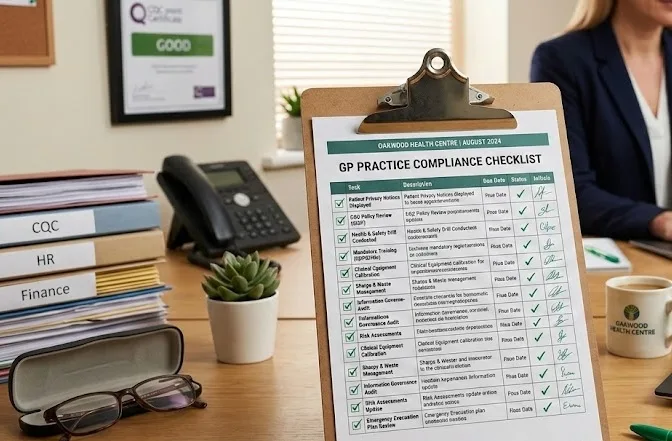
You have read the financial analysis. You have modelled the QOF point changes. But can your practice evidence compliance with the new contractual obligations by April? This checklist covers the implementation and documentation requirements that sit underneath the headline numbers: the things CQC will look for and NHS England can audit. It is designed to be worked through in order, starting with the obligations that take longest to implement.
In brief: The GP contract 2026/27 introduces five compliance-critical changes: mandatory same-day urgent access, mandatory Advice & Guidance without per-item payment, QOF indicator restructuring, practice-level GP reimbursement, and a prohibition on turning patients away. This checklist covers what to implement, what to document, and what to have ready for audit.
How to use this checklist
This is not a summary of the contract. For that, see our 60-second briefing. And it is not a financial guide. Our Follow the Money analysis covers the numbers.
This checklist focuses on what you need to have in place, in your practice, documented and evidenced, before April 2026. Each item links to relevant guidance where it exists and flags where guidance is still pending.
Work through the sections in order. The first two (same-day access and Advice & Guidance) require operational changes that need lead time. The QOF and administrative sections can be tackled in parallel.
1. Same-day urgent access
The 2026/27 contract makes same-day response for clinically urgent patients a binding contractual obligation. This is the single biggest operational change.
What the contract requires
If your practice determines a patient's need is clinically urgent, it must be dealt with on the same day
Your practice defines what "clinically urgent" means, but the assessment must happen, and the response must be same-day
Practices are now explicitly prohibited from asking patients to call back or make contact on another day
For non-urgent contacts, you must respond by the end of the next working day and tell the patient what happens next
Your compliance checklist
[ ] Written triage protocol. Document how your practice assesses clinical urgency. Who makes the decision? What criteria do they use? What happens if they are unsure? This needs to be a written protocol, not an informal arrangement
[ ] Capacity model. Document how same-day capacity is allocated. How many same-day slots? What happens when demand exceeds supply at 4pm? What is the escalation route?
[ ] Staff training records. Reception staff and triage handlers need training on the new protocol. Document the training: who attended, when, what was covered. CQC will ask for this
[ ] Updated reception scripts. The prohibition on "call back tomorrow" needs to be reflected in reception scripts, telephone messages, and any patient-facing communications
[ ] Risk assessment. A significant operational change requires a risk assessment. What are the risks of the new triage pathway? What happens if it fails? See our guide to writing risk assessments that satisfy CQC for the structure
[ ] Online consultation system review. Practices are now prohibited from capping online consultations in a way that forces patients to use another access route. Check your system settings
[ ] Monitoring process. How will you know if same-day access is working? Document what you will measure and how often you will review it
For a deeper look at preparing your operations, see our same-day urgent access readiness guide.
Evidence to have ready
Document | Purpose | Review cycle |
|---|---|---|
Written triage protocol | Evidences systematic urgent assessment | Quarterly |
Capacity and demand model | Shows planned same-day availability | Monthly |
Staff training log | Proves all relevant staff are trained | After each session |
Updated reception scripts | Evidences prohibition on "call back" | As contract terms are published |
Risk assessment for access changes | CQC Safe and Well-led evidence | After implementation, then annually |
2. Advice & Guidance: from optional to mandatory
In 2025/26, Advice & Guidance was an Enhanced Service worth £20 per request. In 2026/27, it becomes a core contractual obligation with no per-item payment.
What changes
A&G use before planned care referrals is now mandatory where clinically appropriate, not optional
The £20 Item of Service payment is being removed
Practices must evidence that A&G is embedded in referral pathways
The expectation is use of A&G via the NHS e-Referral Service (e-RS), though local arrangements may vary
Your compliance checklist
[ ] Updated referral workflow. Document how A&G is built into your referral process. At what point does the clinician check whether A&G is appropriate? How is this recorded?
[ ] Coding and recording. Ensure your clinical system captures A&G requests and outcomes. You need an audit trail showing A&G was considered, used, or deemed inappropriate
[ ] Clinician briefing. All referring clinicians need to understand the new obligation. Brief them on: when to use A&G, how to use e-RS for it, and what constitutes "clinically appropriate" exceptions
[ ] Patient communication. Patients may experience longer waits for specialist opinion if A&G replaces direct referral. Consider how you will explain this
[ ] Financial impact assessment. If your practice was earning significant A&G Enhanced Service income, model the shortfall. Our Follow the Money guide walks through the numbers
Key risk
The biggest risk is that A&G becomes an audit target. NHS England can check whether your practice is using A&G appropriately. A practice that refers heavily without A&G consideration, especially for specialties where A&G is readily available, may face scrutiny.
If your practice was not participating in the 2025/26 A&G Enhanced Service, this transition is more significant. See our 2025/26 Advice & Guidance guide for the workflow foundations. The clinical process is the same, even though the funding mechanism has changed.
3. QOF preparation
The QOF changes for 2026/27 are extensive. Our QOF preparation guide covers the clinical detail. This section focuses on the compliance and documentation actions.
Your compliance checklist
[ ] Register audit: obesity. New indicators OB004 and OB005 (replacing the Weight Management Enhanced Service) require an accurate obesity register. Run an audit now: how many patients have BMI ≥30 recorded? How many have been referred to weight management?
[ ] Register audit: heart failure. New composite indicator HF009 requires patients on all four pillars of HFrEF therapy where appropriate. Identify your HFrEF cohort and check therapy optimisation
[ ] Register audit: diabetes. DM037 is a new composite covering eight care processes. Run a gap analysis: which processes are you achieving and where are the gaps?
[ ] CHOL003 impact modelling. Cholesterol indicator drops from 25 to 5 points. Model the income impact against your current achievement rate. If you have been relying on CHOL003 for income, you need a plan
[ ] Coding templates. Check whether your clinical system supplier has released updated QOF templates for 2026/27. If not, prepare a manual template with the new SNOMED codes as soon as v51 business rules are published
[ ] Vaccination indicators. New indicators VI001/VI002/VI003 require 2-year baselines. Calculate your starting position now
[ ] Asthma register. Now includes patients from age 5 (previously 6). Check your register criteria
Timeline
When | Action |
|---|---|
March | Run all register audits. Model CHOL003 and OB004/OB005 income impact |
March | Calculate vaccination 2-year baselines |
Late March | Watch for v51 QOF business rules publication |
April | Update clinical system templates when released |
April | Begin coding to new indicators from day one |
4. ARRS GP recruitment
The restriction limiting ARRS GP recruitment to recently qualified doctors has been removed. Any GP can now be recruited via the scheme, with the reimbursement ceiling increasing from approximately £106,000 to an estimated £148,000 to £151,000.
Your compliance checklist
[ ] Speak to your PCN Clinical Director. ARRS recruitment is a PCN-level decision. If you want an experienced GP via ARRS, this needs PCN agreement
[ ] Understand the interaction. Practice-level GP reimbursement (the £292m scheme) and ARRS are separate funding streams. A practice could use both: the practice scheme for additional sessions from existing GPs, and ARRS for a network-level experienced GP
[ ] HR governance. If recruiting via ARRS, ensure your employment and indemnity arrangements are current. The Directed Enhanced Service specification will confirm the exact reimbursement figure
5. Administrative and documentation
These are smaller obligations that are easy to miss.
Your compliance checklist
[ ] Patient-facing messaging audit. Review your website, phone message, and reception scripts. Remove any language that asks patients to call back, re-contact, or try again later. The prohibition is explicit
[ ] Online access policy. If you use an online consultation tool, check that your practice does not cap submissions in a way that forces patients to use another route. Capping is now a contract breach
[ ] Non-urgent response protocol. Document how non-urgent contacts are triaged and responded to within the next-working-day deadline. Ensure patients are told what happens next and when
[ ] Contract compliance file. Consider maintaining a single compliance file for the 2026/27 contract year. This is not a contractual requirement, but when CQC inspects or NHS England audits, having your evidence in one place saves time
Pulling it together
The 2026/27 contract is less about money and more about operational obligations. Same-day urgent access and mandatory A&G are the two changes that require the most lead time, and they are the two most likely to be audited.
The pattern across all five areas is the same: document what you are doing, train your staff, and have evidence ready. CQC does not penalise practices for imperfect systems. It penalises practices that cannot demonstrate they have thought about the risks and put reasonable measures in place.
If you are managing compliance across multiple areas (access, A&G, QOF, risk assessments, staff training), a systematic approach helps. My Practice Manager brings your compliance tasks, risk assessments, policies, and staff training records into one place. The AI compliance tools can draft risk assessments, policies, and SOPs from your practice context, so you are not starting from a blank page.
Start with MyPM Explore at £12/month, cancel anytime. Or browse the compliance library to see how the framework fits together.
Further reading
Source: PRN02353 (GP contract letter, 24 February 2026), Annex A, Annex B. BMA analysis of 2025/26 contract. NHS England guidance on same-day urgent access and Advice & Guidance obligations.
Disclaimer: This article is for informational purposes only and reflects understanding as of 1 March 2026. Contract implementation details, including the practice-level GP reimbursement scheme and updated DES specifications, had not been published at the time of writing. Practices should refer to the latest official NHS England guidance and contractual documents.
Published by myPM, 1 March 2026.