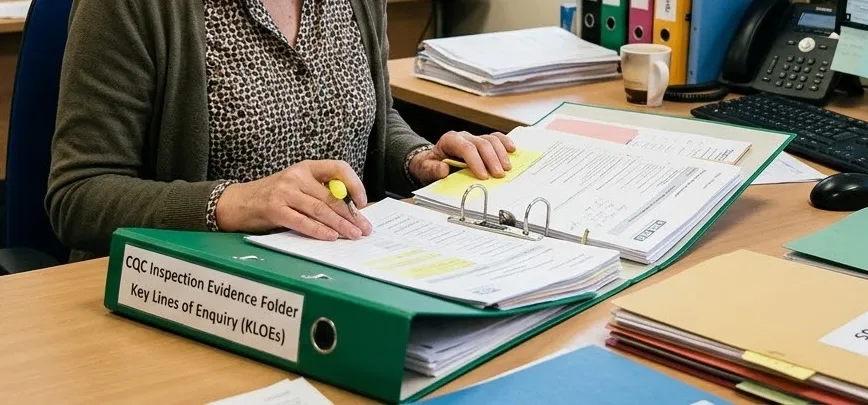
You have received the CQC notification letter. You have roughly two weeks before inspectors arrive at your GP practice or surgery. The question is not whether you can prepare for a CQC inspection -- it is whether you can identify your gaps, produce the missing evidence, brief your staff, and present your practice at its best in the time you have.
In brief: To prepare for a CQC inspection at your GP practice, audit your compliance library, risk assessments, and significant event records against the current quality statements. Use the two weeks before inspection to fill documentation gaps, brief staff on inspector questions, walk through your premises, and prepare a 30-minute presentation covering your strengths and improvement work. If you discover missing documents, My Practice Manager's AI tools can generate them in minutes.
Most CQC inspection preparation guides and checklists available online still describe the old inspection approach. They reference Key Lines of Enquiry (KLOEs) that CQC replaced in late 2023, they do not explain the quality statements that inspectors now assess against, and they do not cover the six evidence categories that structure how CQC gathers and weighs evidence. This guide is current as of March 2026 and covers both the existing framework and the sector-specific changes expected later in 2026.
What to expect when CQC contacts you
How much notice do you get?
For a scheduled inspection, CQC typically gives GP practices two weeks' notice. You will receive a formal notification letter setting out the inspection date, the type of assessment, and a request for information to submit in advance.
However, not all inspections are scheduled. CQC can conduct unannounced inspections if they have concerns about a practice -- triggered by patient complaints, whistleblowing, or data signals such as a spike in safeguarding referrals. These arrive without warning. The preparation you do routinely is your only defence against an unannounced visit.
Focused inspections may also occur with shorter notice. These typically look at a single key question (usually Safe or Well-led) and are triggered by specific concerns rather than a scheduled review cycle.
What information CQC requests in advance
The notification letter will include a provider information request. Expect to supply:
Staff list with roles, qualifications, DBS check dates, and training records
Complaints log with outcomes and evidence of learning
Significant event analysis records from the past 12 months
Clinical audit evidence (at least 2 completed audit cycles)
Patient survey results and how you have acted on feedback
Policies index showing current versions and review dates
Statement of Purpose (the version registered with CQC)
Business continuity plan
Safeguarding referral log
The data you submit shapes the inspection. If it is well-organised and complete, inspectors arrive with confidence in your governance. If it is sparse, inconsistent, or obviously assembled in a rush, they arrive looking for what is missing.
Types of inspection
Type | Focus | Typical notice | Duration |
|---|---|---|---|
Comprehensive | All five key questions across the practice | ~2 weeks | 1-2 days on site |
Focused | One or two key questions, usually Safe or Well-led | Variable (sometimes short notice) | Usually 1 day |
Follow-up | Checking whether previous concerns have been addressed | Variable | Usually half a day |
Focused and follow-up inspections can result in a rating change for the specific key question assessed, which then affects your overall rating.
The CQC quality statements: what inspectors actually assess
The five key questions
CQC's assessment framework is built around five key questions. These have not changed -- they remain the foundation of every inspection:
Safe: Are people protected from abuse and avoidable harm?
Effective: Does care, treatment, and support achieve good outcomes, help maintain quality of life, and is it based on the best available evidence?
Caring: Does the service involve and treat people with compassion, kindness, dignity, and respect?
Responsive: Are services organised so they meet people's needs?
Well-led: Does the leadership, management, and governance of the organisation assure the delivery of high-quality person-centred care, support learning and innovation, and promote an open and fair culture?
What has changed is how these questions are assessed.
Quality statements: the new assessment standard
In late 2023, CQC replaced Key Lines of Enquiry (KLOEs) with quality statements. These are specific, measurable statements of what good care looks like under each key question. For GP practices, the quality statements that matter most include:
Safe
Learning culture: The practice has a proactive approach to safety, based on openness and honesty. Staff feel safe to raise concerns and the practice learns from events, including near-misses.
Safe systems, pathways, and transitions: Safety is managed across the whole pathway of care. Referrals, handovers between teams, and transitions between services are handled safely.
Safeguarding: The practice works with partners to understand and protect people from abuse and neglect. Staff know the signs, know the procedures, and make appropriate referrals.
Involving people to manage risks: People are supported to understand and manage risks to their own health and safety. Risk assessments are documented, specific, and current.
Safe environments: The premises and equipment are safe, clean, well-maintained, and suitable for the services provided.
Safe and effective staffing: There are enough qualified, skilled, and experienced staff deployed to meet people's needs at all times.
Infection prevention and control: The practice prevents and controls the risk of infection. Staff follow appropriate hygiene practices and the environment supports infection control.
Medicines optimisation: Medicines and medicines-related stationery are managed safely. Prescribing is evidence-based, reviewed regularly, and involves the patient.
Effective
Assessing needs: People's physical, mental, and social needs are assessed, and care is planned and delivered to meet those needs.
Delivering evidence-based care and treatment: Clinical care follows NICE guidelines, national standards, and current best practice.
How staff, teams, and services work together: There is effective multidisciplinary working within the practice and with external partners.
Supporting people to live healthier lives: The practice supports prevention and early detection, including screening, vaccination, and health promotion.
Monitoring and improving outcomes: Clinical outcomes are monitored through audit and benchmarking. Where outcomes are below expected levels, the practice takes action.
Consent to care and treatment: Staff understand the Mental Capacity Act and obtain informed consent appropriately.
Caring
Kindness, compassion, and dignity: People are treated with kindness and respect. Privacy is maintained. Staff are empathetic and responsive to emotional needs.
Treating people as individuals: Care is personalised. Cultural, religious, and social needs are considered and met.
Independence, choice, and control: People are supported to be as independent as possible and to make informed choices about their care.
Responding to people's immediate needs: The practice listens to and understands people's needs, views, and wishes, and responds in the moment to minimise discomfort, concern, or distress.
Workforce wellbeing and enablement: The practice cares about and promotes the wellbeing of its staff, and supports and enables them to deliver person-centred care.
Responsive
Person-centred care: Services are tailored to meet individual needs, including communication preferences, disabilities, and the Accessible Information Standard.
Care provision, integration, and continuity: People receive coordinated care. The practice works with other services to ensure continuity.
Providing information: People have access to the information they need, when they need it, in a way they can understand.
Listening to and involving people: The practice seeks and acts on feedback from patients, families, and staff.
Equity in access: Everyone can access the care they need when they need it. Barriers to access are identified and addressed.
Equity in experiences and outcomes: The practice monitors whether different groups of patients have equitable experiences and outcomes.
Planning for the future: People are supported to plan for their future care, including advance care planning and end-of-life care.
Well-led
Shared direction and culture: There is a clear vision and strategy. The culture is open, fair, and supports learning.
Capable, compassionate, and inclusive leaders: Leaders have the skills, knowledge, and experience to lead effectively. They are visible and approachable.
Freedom to speak up: Staff can raise concerns without fear of reprisal. The practice has a Freedom to Speak Up process.
Governance, management, and sustainability: Governance systems are effective. Risks are managed. The practice is financially sustainable.
Partnerships and communities: The practice works effectively with partners (PCN, ICB, community services, social care) to deliver coordinated care.
Learning, improvement, and innovation: The practice has systems for continuous improvement. It learns from events, feedback, and audit. It is open to innovation.
These statements define what "Good" looks like. Inspectors assess your practice against them using evidence gathered through six specific categories.
The six evidence categories and what they mean for your practice
Under the Single Assessment Framework, CQC gathers evidence in six categories. Understanding these is important because they show you where your evidence needs to come from -- it is not just about documents:
Evidence category | What CQC looks at | Example for a GP practice |
|---|---|---|
People's experience | What patients say about the service -- surveys, complaints, online reviews, interview responses | GP Patient Survey results, NHS website reviews, PPG feedback minutes, Friends and Family Test data |
Feedback from staff and leaders | What your team says about working at the practice, culture, and leadership | Staff survey results, appraisal records, meeting minutes showing staff contributions, Freedom to Speak Up evidence |
Feedback from partners | What external organisations say -- ICB, PCN, community services, CQC's own intelligence | PCN meeting minutes, referral feedback, multi-agency safeguarding meeting attendance, ICB correspondence |
Observation | What inspectors see during the visit -- premises, interactions, clinical environments | Clean premises, accessible information, friendly reception, sharps bin compliance, hand hygiene facilities |
Processes | Your documented systems -- policies, protocols, SOPs, risk assessments, audit frameworks | Policy library, SOP folder, clinical audit programme, DBS tracking, training matrix, complaints procedure |
Outcomes | Measurable results -- clinical outcomes, QOF achievement, cancer referral times, patient safety data | QOF points and prevalence data, 2WW referral turnaround, immunisation uptake, prescribing data, Learn from Patient Safety Events (LFPSE) reports |
Most practices focus their preparation on the "Processes" category because it feels most controllable -- updating policies, tidying the evidence folder, writing missing SOPs.
But CQC assesses across all six. A practice with perfect documentation but poor patient survey results and no evidence of acting on staff feedback will not achieve "Good" across the board.
How the Single Assessment Framework works in practice
The SAF means CQC can update your rating based on new evidence at any time, not just after a formal inspection visit. They draw on data they hold (GP Patient Survey, prescribing data, safeguarding referrals, whistleblowing contacts) as well as what they observe during visits.
This has a practical implication for preparation: keeping your evidence current is not just good practice for a scheduled inspection -- it protects your rating between inspections. A significant complaint investigated by CQC between visits could trigger a rating downgrade under the SAF if the evidence suggests a systemic issue.
Your two-week CQC preparation plan
Two weeks is enough to prepare thoroughly if you use the time well. This plan is structured day by day for the first three days (highest priority actions), then week by week for the remaining time.
Week 1: documents, policies, and evidence gathering
Days 1-3: audit and gap analysis
These first three days are about understanding what you have and what is missing. Resist the urge to start writing documents immediately -- you need to know what is needed before you start producing.
Compliance library audit. List every policy your practice holds. Check each one for: current version date, review date, named owner, and whether it reflects actual practice. Flag any policy that is more than 12 months past its review date, any policy that references retired regulations (such as the old KLOEs), and any policy that exists in template form but has not been customised to your practice.
Risk assessment review. Check that you have current, practice-specific risk assessments for: fire, legionella, Control of Substances Hazardous to Health (COSHH), display screen equipment (DSE), general health and safety, lone working, and any premises-specific risks. Each should be dated within the past 12 months and should describe your specific premises, not a generic surgery.
Clinical audit evidence. Identify at least 2 completed clinical audit cycles from the past 12 months. A completed cycle means: first data collection, change implemented, and re-audit showing impact. If you have audits in progress but not yet re-audited, note this -- an incomplete cycle is better than no evidence of audit, but a completed cycle is what inspectors want to see.
Significant event analysis records. Gather all SEA reports from the past 12 months. For each one, check that it includes contributing factors (not just "human error"), documented actions with named owners, and evidence that the actions were implemented. If you have events that were discussed but never written up, they need documenting before the inspection.
Complaints and learning evidence. Compile your complaints log. For each complaint, you need evidence of: timely acknowledgement (3 working days), investigation, response, and -- critically -- what the practice learned and changed as a result. A list of complaints with no evidence of learning is a red flag that triggers deeper CQC scrutiny.
Missing documents? If your audit reveals gaps -- outdated policies, missing risk assessments, SOPs that were never written, significant events that were discussed but never formally documented -- My Practice Manager's AI tools can generate tailored, CQC-ready documents in minutes. Practices across England use the tools to produce policies, risk assessments, SOPs, and significant event analyses that are specific to their practice, not generic templates. Try them free.
Days 4-5: staff records and HR evidence
DBS checks. Verify that every member of staff who requires a DBS check has a current one. Note the date and level of each check. If any are outstanding, escalate immediately -- there is no quick fix for a missing DBS check.
References. Confirm that references are on file for all staff. CQC will check for recent joiners in particular.
Appraisals. Each staff member should have a documented annual appraisal. If any are overdue, schedule them before the inspection if possible.
Training records. Compile a training matrix showing mandatory training completion for all staff. Key areas: safeguarding (adults and children), basic life support, fire safety, infection prevention and control, information governance, and any role-specific competencies. Identify gaps and arrange urgent completion where possible.
Indemnity and registration. Check that all clinical staff have current professional indemnity cover and that registration with their professional body (GMC, NMC, GPhC) is up to date.
Days 6-7: governance and operational evidence
Business continuity plan. Ensure your BCP is current and covers realistic scenarios -- not just pandemic response but also IT failure, loss of premises, and key staff absence.
Statement of Purpose. Check that the version registered with CQC matches your current service provision. If you have changed opening hours, added or removed services, or changed the registered manager, this needs updating.
Meeting minutes. Gather evidence of regular governance meetings: practice meetings, clinical meetings, significant event meetings, and any PCN or multi-agency meetings you attend. Minutes should show agenda, attendees, decisions made, and actions followed up.
Patient feedback evidence. Compile GP Patient Survey results, Friends and Family Test data, NHS website reviews, and PPG meeting minutes. For each source, show what you learned and what you changed as a result.
Prescribing evidence. If your practice has been identified for any prescribing outliers (antibiotics, opioids, high-risk drugs), have your explanation and action plan ready.
Week 2: practice preparation and staff readiness
Days 8-9: the practice walkthrough
Walk through your premises as if you were the inspector. Check:
Reception and waiting area. Clean, accessible, information displayed (complaints procedure, opening hours, how to access services, Accessible Information Standard notices). No confidential information visible from patient areas.
Clinical rooms. Clean, decluttered, hand hygiene facilities (soap, paper towels, hand sanitiser) at every point of care. Sharps bins less than three-quarters full, correctly assembled, dated, and signed. Emergency drugs and equipment present, checked, and recorded.
Specimen handling. Specimens stored correctly, labelled properly, collection process documented.
Infection control. Cleaning schedules visible and signed. Decontamination equipment (autoclave) serviced, logged, and tested. Clinical waste segregated correctly. Curtains clean and dated. Our infection control pre-inspection checklist covers each of these in detail.
Fire safety. Extinguishers serviced, fire exits clear, fire alarm testing logged, evacuation procedure displayed.
Storage. Medicines stored correctly (temperature monitoring for fridges, controlled drugs cabinet secure and registers up to date). No items stored on floors. Storerooms tidy and accessible.
Fix anything you find. An inspector will walk this same route within their first hour on site.
Days 10-11: staff briefing
Every staff member -- clinical and non-clinical -- needs to know what to expect and how to respond. Hold a practice-wide briefing covering:
What the inspection looks like. Inspectors will talk to staff individually. They will ask open questions, not gotchas. Typical questions include: "How do you raise concerns?", "What happened at the last significant event meeting?", "How would you handle a safeguarding concern?", "What training have you completed recently?"
How to respond. Be honest. If you do not know the answer, say so -- it is better to say "I'd check with the practice manager" than to guess. Inspectors are looking for a culture where staff feel confident and supported, not a rehearsed performance.
What the practice does well. Make sure the team can articulate three or four things the practice is genuinely good at. CQC is not only looking for problems -- they want to see examples of good and outstanding practice. If your complaints handling has improved, if you have introduced a new triage system, if patient feedback has improved, the team should be able to talk about it naturally.
Freedom to speak up. Remind staff about the practice's whistleblowing and speaking up procedures. Inspectors will specifically ask whether staff feel able to raise concerns without fear of reprisal.
Days 12-13: the presentation
You will typically have 30 minutes at the start of the inspection to present your practice. This is your chance to set the narrative. Prepare a structured presentation covering:
Who you are. Practice demographics, list size, staffing, PCN involvement.
What you do well. Two or three specific examples with evidence and outcomes.
What you are working on. Honest about challenges and what you are doing to address them. Inspectors respect transparency.
How you learn. SEA process, audit programme, patient feedback mechanisms, and how you act on what you find.
Your response to any previous concerns. If your last inspection raised actions, show what you did about each one.
Keep it factual, concise, and evidence-based. Practice it with a colleague who can give honest feedback.
Day 14: final checks
Evidence folder is organised, accessible, and someone other than the practice manager can navigate it
All documents are the current version with no conflicting drafts visible
Reception team knows who is arriving and how to welcome them
A quiet room is available for interviews
Clinical rooms are clean and fully stocked
You have slept
Evidence folder: what to include for each key question
This section maps specific documents and evidence to each key question. Use it as a CQC inspection checklist to ensure your evidence folder is complete.
Safe
Evidence needed | Where it comes from |
|---|---|
Risk assessments (fire, legionella, COSHH, DSE, H&S, lone working) | Practice-specific assessments, reviewed annually |
Significant event analysis records with implemented actions | SEA register, meeting minutes, action logs |
Safeguarding policies, referral logs, and training records | Policy library, training matrix, safeguarding lead records |
Infection control audit results and cleaning schedules | IPC lead records, signed cleaning schedules |
Medicines management: controlled drugs register, fridge temperature logs, prescribing audits | Dispensary records, CD register, clinical system data |
DBS checks and staff recruitment records | HR files |
Emergency equipment checks (defibrillator, emergency drugs, oxygen) | Equipment check log, weekly/monthly records |
Business continuity plan | Practice governance folder |
LFPSE registration and reporting evidence | LFPSE service records |
Need to generate risk assessments or write up significant events before the inspection? Create practice-specific risk assessments and structured SEA reports in minutes with My Practice Manager's AI tools.
Effective
Evidence needed | Where it comes from |
|---|---|
Clinical audit programme with at least 2 completed cycles | Audit records, meeting minutes |
QOF achievement data and exception reporting rationale | Clinical system QOF reports |
Adherence to NICE guidelines (documented and referenced in protocols) | Clinical protocols, prescribing formulary |
Multidisciplinary working evidence (PCN meetings, referral pathways) | Meeting minutes, shared care agreements |
Screening and immunisation uptake data | Clinical system reports, national screening programme data |
Staff appraisals and continuing professional development records | HR files, appraisal records |
Consent procedures and Mental Capacity Act policy | Policy library, consent form templates |
Caring
Evidence needed | Where it comes from |
|---|---|
Patient survey results (GP Patient Survey, FFT) with response actions | Survey reports, action plans |
Patient Participation Group meeting minutes and outcomes | PPG records |
Complaints with evidence of compassionate, timely responses | Complaints log, response letters |
Accessible Information Standard compliance evidence | AIS policy, communication needs register |
End-of-life care planning evidence | Palliative care register, advance care plans |
Responsive
Evidence needed | Where it comes from |
|---|---|
Access data: appointment availability, wait times, online booking usage | Clinical system reports, NHS App data |
Complaints log with trends, themes, and learning actions | Complaints register, governance meeting minutes |
How you act on patient feedback (specific examples of changes made) | Feedback action log, "you said, we did" evidence |
Extended access provision (evenings, weekends) | Rota, appointment system data |
Home visit policy and delivery | Clinical protocols, home visit records |
Translation and interpretation arrangements | Policy, interpreter booking records |
Missing complaints response documentation? Generate professional, CQC-compliant complaint responses from your case notes in minutes.
Well-led
Evidence needed | Where it comes from |
|---|---|
Practice development plan or strategy document | Practice governance folder |
Governance meeting structure and minutes | Meeting records showing regular cadence |
Risk register (practice-level, not just clinical) | Governance records |
Financial sustainability evidence | Accounts summary, budget plans |
CQC registration details (Statement of Purpose, registered manager) | CQC portal records |
Staff Freedom to Speak Up policy and evidence of use | Policy library, FTSU records |
PCN engagement evidence | PCN meeting minutes, shared roles |
Quality improvement projects with outcomes | Quality improvement (QI) records, Plan-Do-Study-Act (PDSA) cycles |
Assemble your evidence folder faster. If your compliance library audit reveals missing policies, outdated SOPs, or risk assessments that need rewriting, My Practice Manager's compliance library covers all 11 compliance domains with AI document generation. Generate the specific documents your evidence folder needs.
On inspection day: what actually happens
The 30-minute presentation
You present to the inspection team. Keep to time. Cover your strengths, your challenges, and what you are actively improving. Inspectors appreciate honesty more than polish. If you had a difficult period -- a partner left, a complaints spike, a staffing crisis -- say so, and show what you did about it.
The practice walkthrough
The lead inspector walks through the practice, usually starting at reception and moving through clinical and non-clinical areas. They are looking at the physical environment, how staff interact with patients, and whether what they see matches what the documents say. A policy that says "hand hygiene is performed between every patient contact" is tested by observing whether hand sanitiser is available and visibly used.
Staff interviews
Inspectors speak to clinical and non-clinical staff individually. They are not looking for rehearsed answers. They want to understand:
Whether staff feel supported and can raise concerns
Whether staff know the practice's safeguarding and incident reporting procedures
Whether clinical staff can explain how they make prescribing and referral decisions
Whether reception staff know how to handle urgent requests and safeguarding disclosures
The culture of the practice becomes visible in these conversations. A team that is genuinely well-led will demonstrate it naturally.
Patient and stakeholder feedback
Inspectors may speak to patients in the waiting room or review patient group feedback. They will also consider data they hold: GP Patient Survey results, NHS website reviews, complaints received directly by CQC, and feedback from the ICB or other partners.
The debrief
At the end of the visit, the lead inspector provides verbal feedback. This is not the final rating -- the report goes through a quality assurance process -- but it gives you an indication of areas of strength and concern. Take notes. Ask for clarification on anything you do not understand.
After the inspection: ratings and next steps
Understanding CQC ratings
Rating | What it means |
|---|---|
Outstanding | The service is performing exceptionally well |
Good | The service is performing well and meeting expectations |
Requires Improvement | The service is not performing as well as it should, and improvements are needed |
Inadequate | The service is performing badly and action is needed |
Each of the five key questions receives its own rating. The overall rating is a composite. A practice rated "Good" overall can have individual key questions rated "Requires Improvement" -- but a single "Inadequate" rating on any key question will normally limit the overall rating to Requires Improvement at best.
If you receive "Requires Improvement"
A "Requires Improvement" rating is not a crisis, but it does require structured action to improve your CQC rating:
Read the report carefully. Identify the specific concerns under each key question and the "must do" and "should do" actions.
Create an action plan. For each concern, document what you will change, who owns it, the deadline, and how you will evidence the improvement.
Address "must do" actions first. These relate to breaches of regulation and must be resolved. "Should do" actions are recommendations -- important but not legally mandated.
Evidence everything. When you make changes, document them. Keep a specific "post-inspection improvement" folder that tracks each action from concern to completion.
Request a re-inspection. Once you have implemented your actions and can evidence sustained improvement (typically 6 months minimum), you can request that CQC reassess the relevant key questions.
Building your improvement plan. My Practice Manager's compliance library can help you systematically address gaps identified during inspection. Generate the policies, risk assessments, and SOPs that your action plan requires, all tailored to your specific practice.
Special measures
An "Inadequate" rating triggers special measures. CQC will issue enforcement actions, which may include:
Warning notice: You must make specified improvements within a set timeframe.
Conditions of registration: Additional requirements placed on your practice.
Suspension or cancellation of registration: In the most serious cases.
Urgent action: If there is an immediate risk to patients.
If you are placed in special measures, work with your ICB and LMC immediately. Both can provide support, and your LMC may be able to connect you with experienced practice managers who have been through the process.
The 2026 framework changes: what is coming
From Single Assessment Framework to sector-specific frameworks
CQC is moving from a single framework applied across all sectors to sector-specific assessment frameworks. For GP practices, this means the framework will be tailored to primary care rather than being a generic healthcare framework adapted for general practice.
Timeline
Spring 2026: CQC analyses consultation feedback and develops draft sector-specific frameworks
Summer 2026: New sector-specific frameworks published
End of 2026: Implementation begins
What this means for your next inspection
If your inspection is scheduled before the new frameworks are implemented (likely before autumn 2026), you will be assessed under the current Single Assessment Framework and quality statements as described in this guide.
If your inspection falls during or after the transition, the sector-specific GP framework will apply. CQC has indicated that the five key questions will remain the foundation, but the quality statements and evidence requirements may be refined to better reflect primary care practice.
The practical implication: if you are preparing under the current framework, everything in this guide applies. If your inspection is likely to fall in late 2026 or 2027, monitor CQC's provider guidance pages for updates to the GP-specific framework.
Regardless of framework changes, the fundamentals remain constant: safe care, effective clinical practice, compassionate service, responsive access, and strong governance. A practice that genuinely delivers these will meet any framework CQC applies.
Frequently asked questions
How much notice does CQC give for a GP practice inspection?
CQC typically gives GP practices approximately 2 weeks' notice for a scheduled inspection, including the inspection date and a data request. However, CQC can conduct unannounced inspections at any time if they have concerns, triggered by complaints, whistleblowing, or data signals. Focused inspections may arrive with shorter notice. The best preparation is maintaining inspection-ready documentation and governance systems at all times.
What documents does CQC request before the inspection?
CQC sends a provider information request covering your staff list, complaints log, significant event records, clinical audit evidence, patient survey results, policies index, Statement of Purpose, business continuity plan, and safeguarding records. The specific request varies by inspection type, but having all of these ready and well-organised demonstrates strong governance before the inspector even arrives.
How long does a CQC inspection last?
A comprehensive inspection typically lasts 1 to 2 days on site, depending on practice size. A focused inspection usually takes 1 day; a follow-up may take half a day. The on-site visit is only part of the process -- CQC also reviews data, receives feedback from patients and partners, and conducts quality assurance on the report before publishing.
What happens if you fail a CQC inspection?
There is no pass or fail in CQC terms. Practices receive a rating from Outstanding to Inadequate for each key question and overall. A "Requires Improvement" rating means the practice must create and implement an action plan. An "Inadequate" rating triggers special measures, which can include warning notices, conditions on your registration, or suspension of registration. Most practices that receive "Requires Improvement" achieve "Good" on re-inspection after implementing their action plan.
How often does CQC inspect GP practices?
There is no fixed inspection cycle. Under the Single Assessment Framework, CQC monitors practices continuously and can update ratings based on new evidence at any time. Most GP practices rated "Good" are inspected every 3 to 5 years. Practices rated "Requires Improvement" or "Inadequate" are reinspected more frequently, typically within 12 to 18 months. New practices or those with a change of registration are inspected within the first 12 months.
Can you prepare for an unannounced CQC inspection?
You cannot prepare for a specific unannounced inspection, but you can maintain inspection-ready standards at all times. This means: keeping policies current and reviewed on schedule, documenting significant events promptly (not retrospectively), maintaining staff training records, acting on patient feedback regularly, and ensuring the physical environment is always clean and safe. A well-governed practice is always inspection-ready.
What is the difference between the old KLOEs and the new quality statements?
KLOEs were investigative questions inspectors asked; quality statements describe what good care looks like. KLOEs followed the format "How does the practice ensure...?" while quality statements, introduced in late 2023, follow the format "We have a proactive and positive culture of safety, based on openness and honesty." The five key questions (Safe, Effective, Caring, Responsive, Well-led) remain the same. The shift is from "what inspectors ask" to "what the practice should demonstrate," assessed using six evidence categories: people's experience, staff and leader feedback, partner feedback, observation, processes, and outcomes.
Whether your inspection is scheduled for next week or next year, the fundamentals of CQC inspection preparation remain the same: maintain your evidence, train your staff, act on feedback, and document your learning. A well-governed GP practice or surgery is always inspection-ready.
If your preparation has revealed gaps in your compliance library, My Practice Manager's AI tools can help you generate the policies, risk assessments, SOPs, and other documents you need. Start for free.
This article is for informational purposes only and reflects understanding as of March 2026. It does not constitute legal, financial, or medical advice. Practices should consult with relevant professional bodies or legal counsel for specific circumstances and always refer to the latest official guidance from CQC, NHS England, and the BMA.